The Environment Agency has released new guidelines for natural flood management, drawing on the expertise of UBoC researchers.
The new guidelines evidence the ways in which environmental management can help nature play its role in improving the UK’s resilience to flooding and coastal erosion.
UBoC research provides new evidence that woodlands slow the flow of water and reduce downstream flood risk. Until recently there was limited evidence of the impacts of woodlands in the UK. Our researchers found that broadleaf woodland catchments have approximately 55% lower flood peaks compared to grassland catchments. This reduction in flood risk occurred even during large storm events that typically take place every 1 to 2 years.
UboC researchers made soil and streamflow measurements across three woodland catchments and six grassland catchments. Woodland soils were 11 to 20 times more permeable than grassland soils, allowing water to enter the soil more quickly, slowing the rate water reached the river and reducing the flood peak.
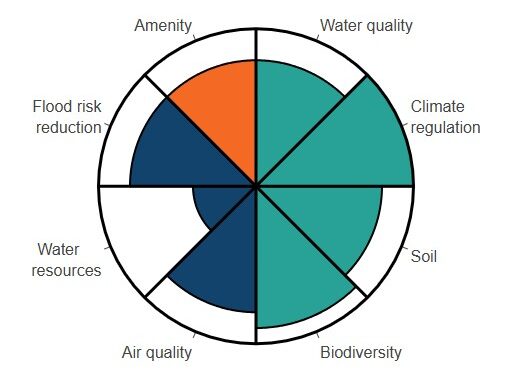
The benefits of catchment woodland, as reported in the new woodland management document.
Reducing downstream flooding is an important benefit of woodland creation. Our researchers are now tracking the change in river flow at a number of UBoC-supported projects including Snaizeholme, Restoring Hardknott Forest and Upper Duddon, and Wild Ingleborough. The UBoC study cited in these new guidelines is freely available in the journal Hydrological Processes.
The Environment Agency evidence is broken down into documents highlighting the effects of Rivers and Floodplains, Coasts and Estuaries, Run-off Management, and Woodlands. The woodland management document cites research from Dr Felicity Monger’s PhD research at the University of Leeds, which was funded by UBoC.

Streamflow measurements in progress, using a V-notch weir